
32
Weeks, Months, Years, Oddities.

I am finally freer to write more often. For the last 8 weeks, I had been curating an introduction to machine learning for healthcare professionals, and it was the subject of a wild gamble. This was a unique position to consolidate everything I have learnt. And then quickly break it down into principles I could give these folks instead of having them spend weeks fighting a programming language or even statistics for that matter (huge offense to the natural order). I did not know that there is a very short distance between your unconscious mind teasing something in your life and you making it happen. This was legitimately the tease. Math does find you.
Alliteration
I picked the most interesting word to describe a specific rhythm that I could find in my brain dictionary. The story of 32 is unique in many ways, and after conjuring it up 3 weeks ago, I decided today would be the milestone I sit down and consolidate these stories. Its use as time is a very specific time milestone, in the funniest of ways. The most distant of which I was born on a Thursday. And that my name has all the makings of someone who was born later than they were expected. I hid one there; you have to know me really well to figure out what I just slotted inside those 3 sentences, the real milestone. The likes that a Dr Keziah Nyakundi can spot in seconds.
Concept
32 years ago, a Dave Snowden fella was about to etch his name in history by attempting to explain (a few years later, I just wanted to use 32 for literary effect) one way to make sense of complex things. He will come back later. His work, amongst many others I found myself exploring, ended up assisting me. In trying to explain — to myself — a fundamental thing about competence.
I was still a concept when he was fervently developing his thought process; now I am not. Buckle in. I implore you. It is longer than my usuals.
Teacher
One might wonder what goes on in the mind of a 32-year-old teacher. Several years have passed, and you have seen enough students to form polarizing opinions about the human psyche, but you keep them to yourself. Some of these opinions you, as a teacher, would keep encountering every single day, may find their way into the general public. Depending on your experience as a teacher, you would prepare your students with this information.
As a member of the general public, I have encountered a few. Opinions. I keep gnawing at them in the spirit of self-teaching; I doubt they will reach 32 in number. Being directly responsible for knowledge acquisition on behalf of another person is such an honour. I look at my pops differently professionally now. I appreciate deliberate practice and its benefits for skill acquisition, and it pains me to even put those words together. We could have been trading kamande for ducks and going home to slaughter the sick hen that is older than the family's lastborn, for supper.
Instead, we are really caught in a bind, huh. And we have to try to make it out one way or another. And unfortunately, we know it could be better elsewhere, or if certain people were not short-sighted. I saw a certain brilliant author here encapsulate everything.

It was ambitious to try to pen this in a day. This is not a one-day affair. I just came across damning information (might not tell you).
And even more (day two sasa). I told you, Kez, you just added sections to this article. Target acquired.
Mentorship
Fear
The Weight
The more I learn generally, the more I want to share. I always do this, and I keep finding myself listening to a very subtle piece of knowledge that would have taken you years to find out, from someone next to me. I always feel alive when this happens. I suspect there are many of you susceptible to the same… I genuinely lack the word forgive me I will skip it entirely.
As an evolving mentor, I am happy. I can summarise a few things I keep finding, and if I meet you, I will tell you in greater detail. Since I found myself down a rabbit hole, I just might share a few.
I can tell you that this paragraph has been so slow to type because of the heaviness. I cannot believe I put an actual physical limit on my speed while racing to describe it. You would describe it better, wouldn’t you? Easter egg.
Laughing because days have passed, and I am still delivering this article late. I lied to myself that if I got freer, it would automatically mean I churn out more of these.
But.
Discipline
Together with its cousins. The dedications, determinations, etc., of this world. Are potentially the wrong way of looking at career next steps. We all know that. Your mentor has already told you what matters. We also just do not have a way to clearly figure out the direction towards which to channel all those glorious adjectives in pursuit of greener pastures.
Take a step back, though, before the decision to commit to, or pivot towards, anything remotely requiring an exchange of your intellect for livelihood.
Find it. The uniqueness within which your mind settles when new info comes in, and what it decides to do with it. An example, I always explore what could be. By default. A reaction I have to literally any news. Possibilities. A huge burden. Huge if not optimized for the right environment.
The right environment
Could be the next phase of your career, matching well with how you usually approach problems. Mihaly Csikszentmihalyi and his colleague Jacob Getzels, from the 1960s onwards, were discovering something fundamental about mastery.
Whatever curriculum you underwent may have exceedingly rewarded solving problems over all else. Fairs. People ahead of you, however, become ‘a master of their craft’ because they frequently discover problems quickly, and build on the problem-solving skills they are currently good at. One explanation comes from our duo, M and J above.
Intellectual challenges in general are presented to you. Or you discover them (1)(2)(read 2 its interesting). And you solve them. Someone compensates you. We buy a GLE (wink).
Those presented to you may have a clear formulation or objective. Even resolution. Settling on a diagnosis, or the answer to a locus question, will be a good example here. Your role is to execute the competence you established. My attempt at positioning discovery in a better light — as you read along — is in no way meant to derogate solving problems and getting paid for it. Rather, an extra thought at the back of your mind, that can help you professionally pick the right environment next time. A thought. Just a thought.
A discovered problem will require you to be proactive in identification and articulations from the jaws of… again, could not find a word. You will probe your environment for structure to apply to a challenge not clearly defined to you before, figure out the constraints, and find the right frame of questions that will guide your problem-solving. M and J.
This other gentleman was addressing President George W. Bush in 2001, less than 32 years ago, talking about ‘bro, we need to plan’ (3). Read it. It’s short. Really not my jam, using an example from these folks. Bear with me, lakini. Donald Rumsfeld was referring to preparation for war (they always are) because of how the previous decades had been. But you cannot know everything beforehand; instead, a few months later, what would evolve to be the Rumsfeld Framework was born.
What you don’t know won’t hurt you
For Rumsfeld and the amplifiers after him, whatever you do (professionally) may be known or unknown to you.
A known known is a documented solution to a clearly understood problem.
A known unknown will be where scientific research and predictive analytics you do to create shareholder value fall. People are aware of gaps and how to close them.
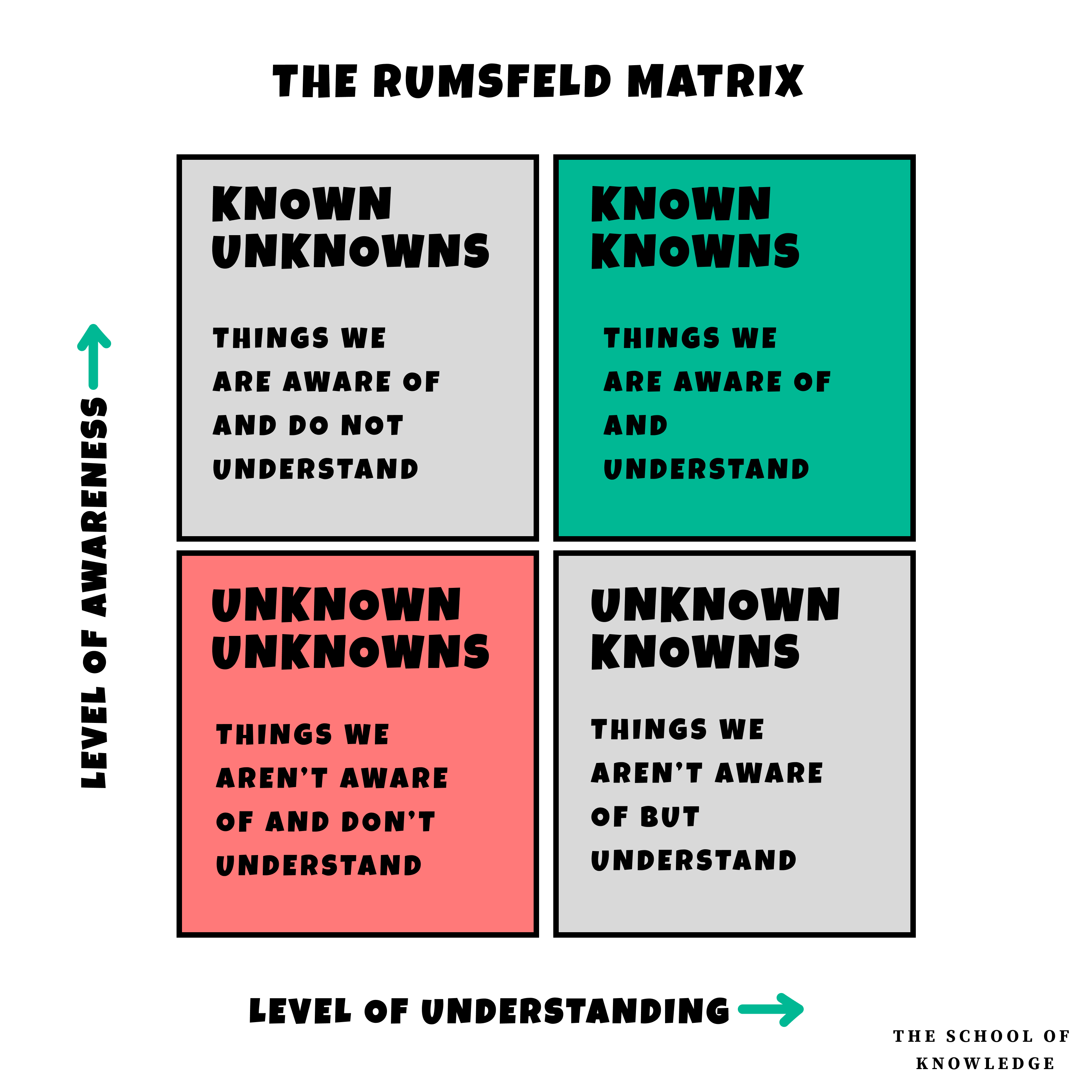
An unknown unknown is probably what founders like fighting. With foresight (strategic), exploration, and much of what formative/explosive entrepreneurship encourages.
Surprisingly (introduced later), we also have unknown knowns. Info exists, structurally invisible to you.
That was take 1.
Dent
It is amusing. For you to make meaningful scientific contributions today, you have a mountain of research to do before you can move a needle. There is so much work already discovered, and a huge chunk of it is waiting for you to read it, internalise, even compare and borrow across disciplines, even to make a dent. Riveting experience for me.
I once reduced variation within scientific disciplines to LEGO blocks. Modularity being the important principle that I was hinting at. And abstraction and rigorous testing. Not going to give you all my notes, find yours.
An interesting example of this is how the two largest EV makers approached the story as a whole. Homework for you.
But when you finish reading all the research and begin work, you can still get it wrong. What you might gather from the video is what happens when you look for problems to solve while you are catching up.
Catching up
Looks like an alternation between what Thomas S. Kuhn called normal science and scientific revolutions. A paradigm you would have subconsiciously picked in your environment without reading about here. Kuhn’s approach in The Structure of Scientific Revolutions described the alternating nature as opposed to a linear, unbroken accumulation of facts (4). Normal science will fit nature into a preformed and relatively inflexible conceptual box that, for example, trainees in healthcare will indulge in. An atypical comorbidity is only initially a complex puzzle to solve, and it melts when you stare long enough. Rock bottom sometimes has a basement, and this is recognition for all medical practitioners out there.
The average Nairobi fintech founder will live closer to paradigm creation or revolution. Techies wako somewhere hapo katikati (I love it here).
Return
To the Snowden fella. Endea maji kwanza halafu urudi. The Cynefin Framework.
This gentleman looked at behavioral orientation to problems, the output of which eventually morphed into four primary domains: Clear (or Simple), Complicated, Complex, and Chaotic, alongside a central domain of Confusion or Disorder (5).
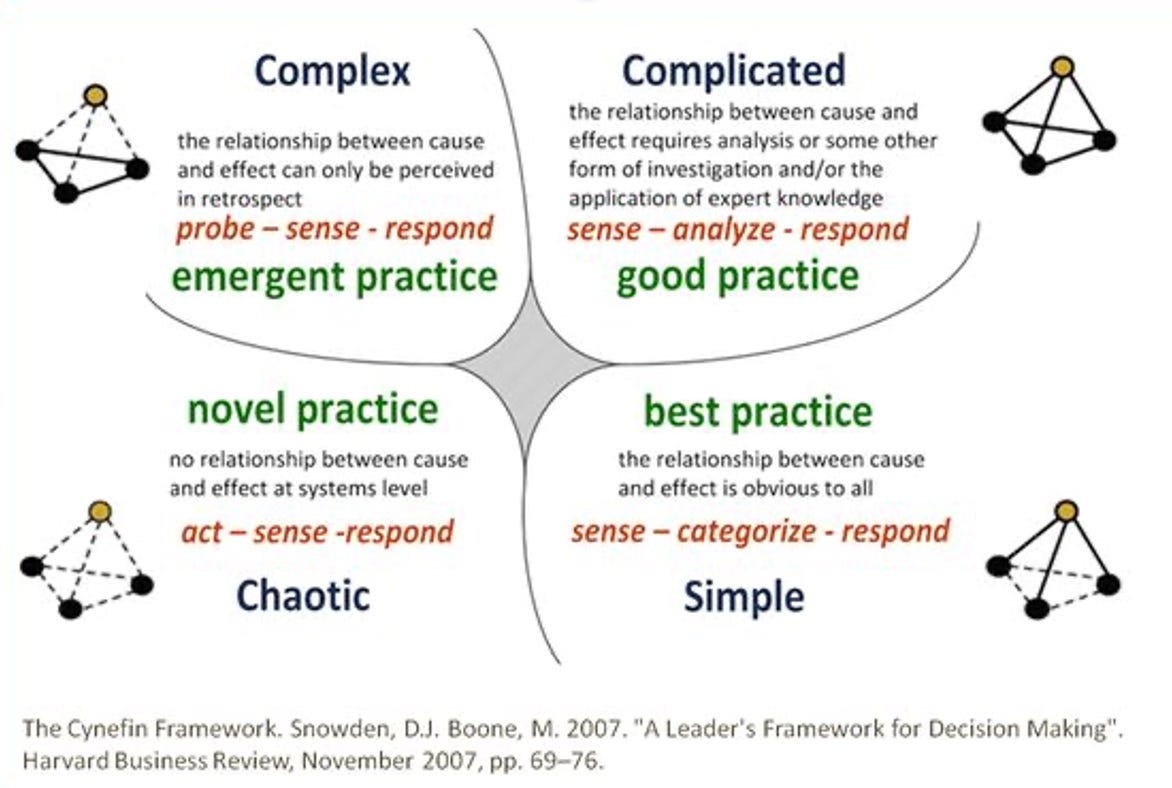
To our right, the orientations you are seeing, the complicated or simple nature of problems, represent ordered systems. Order because cause and effect are discoverable and predictable.
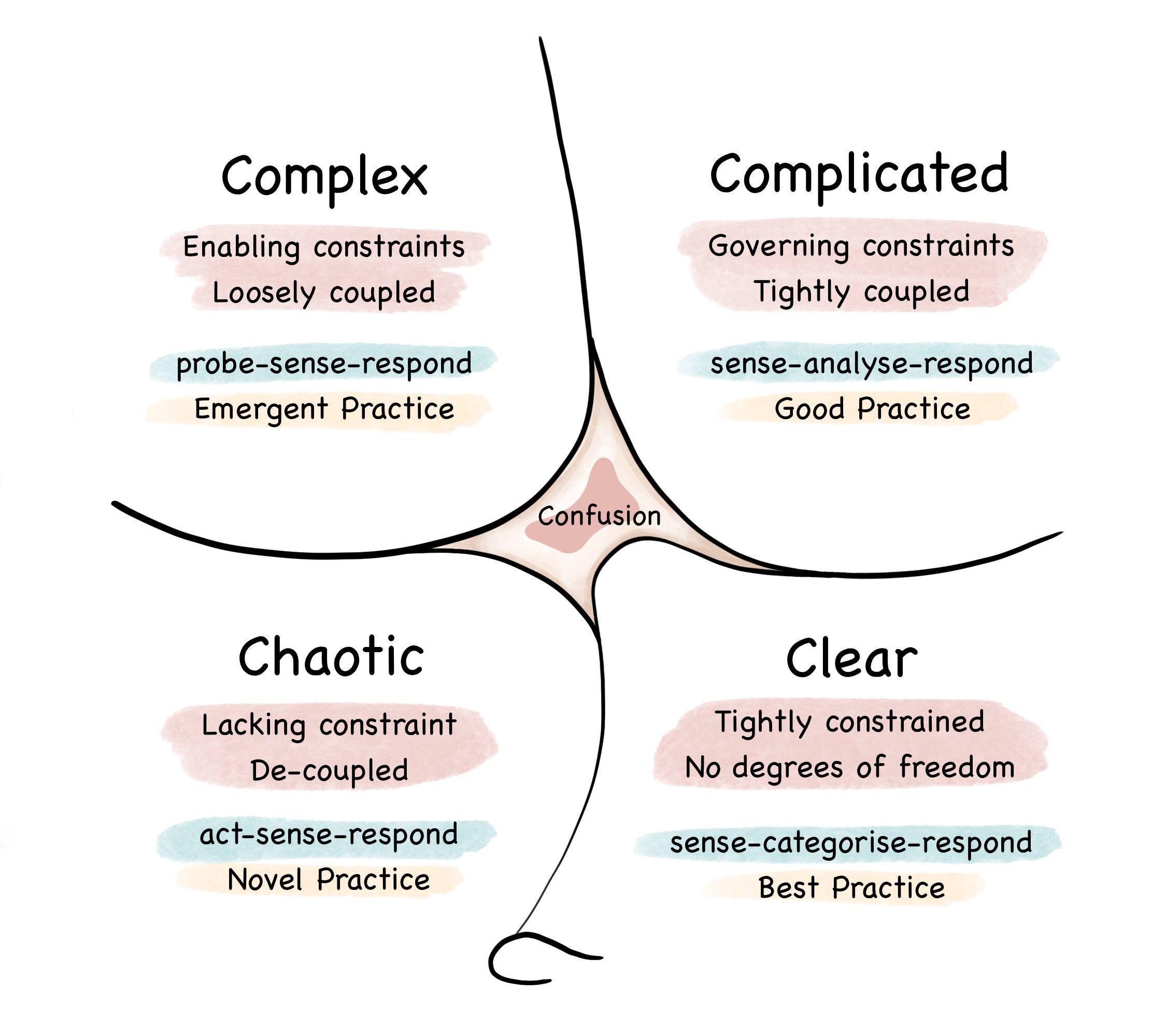
In the Clear domain, the relationship between cause and effect is self-evident; established rules and best practices apply, and the cognitive approach is to "Sense, Categorize, and Respond". The aspects of your daily life that are in your control. Count them in your hand, try to exhaust all 10 fingers. I dare you.
In the Complicated domain, known as the realm of "known unknowns," cause and effect exist but require expert analysis or algorithmic calculation to uncover. And the approach here is "Sense, Analyze, and Respond". For example, adjusting dosages because of age. Or fighting GPT 5 mini when it writes bugs instead of software.
To our left are unordered systems.
In a Complex system, cause and effect can only be deduced in retrospect; there are no clear right answers, only emergent patterns that cannot be fully predicted through reductionist analysis. Here we "Probe, Sense, and Respond," utilizing experimentation and adaptive learning. Like trying to keep Covid-19 at bay. Some fools decided to replicate this problem again in 2026 with another (preventable) crisis. Smh.
In a Chaotic environment, the system lacks any perceivable order, and immediate, decisive action is required to establish stability ("Act, Sense, Respond"). Another nod to healthcare professionals. Medical emergencies…
The actual bone
I thought about this article some time back. Easter egg for Keziah to find out what I am talking about when I say week 29. Born from a decision to explore why, in certain careers, it always seems like you are playing defence. And if defence is not your style (I embody this), the friction you experience is out of this world. The defence in question includes some of the things we have talked about, like clear and complicated, just now. Or the knowns. To some extent.
I am warming up to offence generally, and before rushing to even discuss this with someone, I dug deeper and started throwing these buzzwords at you. That was the inspo. And then the brilliant Dr Keziah Nyakundi kept introducing me to more POVs, and I decided to immortalize her intellect in this article.
Lakini Hatujamalizana
There is more.
Dynamics rather.
Resources. And Balance.
Deciding between discovering new possibilities and optimizing existing capabilities. Someone else has also attempted to break this down. Surfacing it because if you plan on advancing your career, this might even be a clever way to vet the team you're going to work with. Or the culture you create; should you try to create a billion-dollar business with Claude. Make no mistakes.

3rd floor
Essentially, what we’re working through today is the frame of thinking I would assume is happening when, you know, you turn 32.
“Bado nataka kufanya hii kitu?”
James G. March’s research, for those who are still going to be tied to a mjengo, attempts to position an organization’s thinking into exploration or exploitation (6). That is, whenever we think about problems, as part of the band that we find ourselves a part of (and getting compensated for), with whom we solve/discover said problems, the thesis we tend to have falls into the two positions I have just introduced. Kizungu. Ptho.
Exploitation involves the refinement, implementation, efficiency, execution, and optimization of known certainties. Maximizing immediate returns. Stakeholder value. Insights. Big data. Machine learning. Pop culture. I digress.
Exploration, on the other hand, involves search, risk-taking, experimentation, flexibility, and the discovery of entirely new paradigms.
And then there is you, newly employed. Onboarding materials are handed to you to the extent of the decorum your work environment affords. There is a gap between what you know and what the organization has accumulated as its knowledge.
Exploit in the short term. Returns are immediate, I just mentioned. Exploration yields returns that are uncertain, distant in time, and often realized by the broader systemic ecosystem rather than the individual exploring unit. Some of us might lean towards the latter, usually a good time to reconcile with the fact that you need to start your own shop. Not sure how you will assess yourself, leap. The fall is only 2 floors anyway.
Hear me out.
Organizations that engage exclusively in exploitation suffer from strategic drift and long-term obsolescence; they become hyper-optimized for an environment that is constantly evolving, rendering their efficiencies suddenly useless. It is not an environment you want to spend your heyday in if your voice, calling out to whoever listens, is ignored. A voice that would emerge if that cat and mouse game is boring and you want to effect some change. Change towards exploration. Organizations that engage exclusively in exploration suffer from the exhausting costs of endless experimentation without ever capturing the economic value or stability of their discoveries. Like Ousmane Dembele (The World Cup is upon us), both feet giving the same output is ideally where you would want to be. Exploration will create new possibilities, exploitation will maintain them.
Cults
The mentor I have for this current phase of life, I get to work with them daily. So happy, man. Nod to you, Silas. We were discussing, born from my self-confession, how maintenance in the problem orientation space (the one I have just introduced you to for the past 7 (32) minutes) does not have good PR. In the modern corporate, technological, and public policy zeitgeist, the generative aspect of problem orientation has been elevated to an ideological cult. The Innovation Delusion, as Lee Vinsel and Andrew L. Russell encapsulated in their research and book (7).
An almost vacuous rhetoric (this innovation-speak) that glorifies disruption, design thinking, lean startups, and the Silicon Valley ethos of moving fast and breaking things, while systematically marginalizing the essential, ongoing work of maintenance, repair, and care. Like these blokes.
It frames innovation as an inherently positive, self-evident metric of progress, distracting policymakers, educational institutions, and corporate boards from investing in the fundamental infrastructure that sustains collective life. That incomplete picture is messing us up as a species, damn. Some catastrophic infrastructure failures happen when societies and professions prioritize the creation of new possibilities over the prevention of future problems and the management of existing systems. The terminal consequences of such an innovation-centric economic model are that it starves operational upkeep to fund flashy capital projects.
The vast majority of the work we do as human beings is maintenance (8). Unfortunate that despite forming the absolute substrate of modern civilization, professions tied to maintenance are systematically rendered invisible and economically undervalued. Generative work (creating a new application or erecting a new building) is highly visible, legible, and easily attributed to a creator. Maintenance and preventive work (preventing a server crash, averting a structural failure, vaccinating a population) is defined entirely by the absence of a negative event. Because human beings and institutional structures struggle to value and measure non-events, preventive and maintenance-oriented professions continually struggle for societal prestige and capital allocation compared to their generative counterparts. Helpful to know before you make the leap, or pivot. If this kind of thinking has started making sense to you.
Now
You are about to transition from the general curriculum to the world we were never prepared for. I am trying to prepare you to think about it deeper than you probably ever have. Away from compensation and other niceties that a career transition can bring. You will go from being competent (known knowns), to being an expert (complicated problems do not faze you), mastery (taking it up a notch higher and relying more on your understanding of system dynamics), to wisdom (where you also balance ethics and long-term thinking).
Distraction, watch this too. I beseech you.
Loose as it was, if we decide to count new things we have learnt today, I sincerely hope they exceed 32. Congratulations if you are already past 32. If you are not, the brain achieves structural stability at 32. And remains stable for about 32 more.
Use that information how you see fit.
https://edcircuit.com/important-overlooked-aspect-of-creativity/
https://thereader.mitpress.mit.edu/the-1960s-art-school-experiment-that-redefined-creativity/
https://library.rumsfeld.com/doclib/sp/2382/2001-04-12%20To%20George%20W%20Bush%20et%20al%20re%20Predicting%20the%20Future.pdf
https://en.wikipedia.org/wiki/Paradigm_shift
https://castintelligence.com/blog/cynefin-framework/
https://cora.ucc.ie/items/47974831-f18a-40d2-aff7-6b7d8266d305
https://www.amazon.com/Innovation-Delusion-Obsession-Disrupted-Matters/dp/0525575685
https://revistas.ufpr.br/novation/article/download/102433/76422/453155
1. I've given up trying to figure out what pattern Keziah would find in seconds.
2. Thanks for the shoutout.
3. I first encountered that Rumsfield line in a Boondocks episode parodying Tarantino's "Pulp Fiction". It's incredible how rationale for a war was built from nothing.
4. ModernMBA's breakdown of the EV industry approach of US vs China is thoroughly incredible. I wonder if hindsight makes his insights better, or whether they were apparent from the start.
Was yesterday your 32nd birthday?
My younger brother would love this article. Let me send it as of where I am.
How does one get a preview of your intro to ML course? I am curious.
i barely use Youtube but that is an intentional share. I will check it out.